
Why Would Anyone Spend That Much on a Guitar?
Let me be upfront about something. The first time someone showed me a handmade guitar and mentioned the price, my reaction was probably the same as yours right now: you could buy a decent used car for that money. What on earth makes a stringed instrument worth five, eight, sometimes fifteen thousand dollars or more?
I spent years asking that question. Then I played one. And somewhere in the first thirty seconds, I started to understand.
This piece isn't here to sell you anything or make you feel like your current instrument isn't good enough. It's just an honest look at what the handmade instrument world is about — what players are actually seeking when they go down that road, and whether any of it makes sense for you.
First, Let's Talk About What You're Playing Now
Most instruments sold today are factory-made. That's not an insult — modern manufacturing is genuinely impressive. CNC machines can route a guitar neck to tolerances tighter than most human hands can achieve. Quality control has improved dramatically over the past few decades. You can walk into a music store today and buy a perfectly playable guitar for a few hundred dollars that would have seemed miraculous to players fifty years ago.
But here's what happens on a factory floor: every decision gets made for the average player, at a price point that makes the math work. They select the wood for consistency and cost, not for the particular way that specific piece resonates. The internal bracing — the wooden skeleton inside the body that shapes the sound — gets stamped out the same way for every unit. The finish goes on thick and fast, because time is money, and a heavy finish seals the wood and dampens the very vibration you're trying to encourage.
None of this makes a factory instrument bad. It just makes it a product built to a specification, rather than an instrument built to sing.
A handmade instrument isn't a better version of a factory instrument. It's fundamentally different, built with different intentions.
So What Does a Luthier Actually Do Differently?
A luthier makes stringed instruments. The word comes from the French for lute, but today it includes guitar builders, mandolin makers, banjo builders—anyone working at the level of craft rather than production.
When a luthier selects wood for an instrument top, they're not just picking a grade from a catalog. They tap the board with their knuckle and listen to how it rings. They flex it slightly and feel how stiff it is. They often use specialized measuring equipment to adjust the guitar top's tone by altering its thickness in targeted areas. That specific piece of spruce or cedar becomes the voice of that instrument, and a good builder knows what they're working with before the first cut.
The bracing — those thin strips of wood glued to the inside of the top — gets shaped and tuned by hand. A builder will shave a little from this brace, add a touch to that one, tap the plate and listen again, until the response feels right for that instrument. No template can do this, because no two pieces of wood are identical.
Finish gets applied thinly — often old-fashioned nitrocellulose lacquer, sometimes just oil — because the goal is to protect the wood without suffocating it. A thin finish lets the wood vibrate freely. And that matters more than people realize.
The setup—adjusting string height, nut slots, and saddle—is the final act of care, dialed in until the instrument plays as easily as it can.
Guitars: Finding Your Voice in Wood
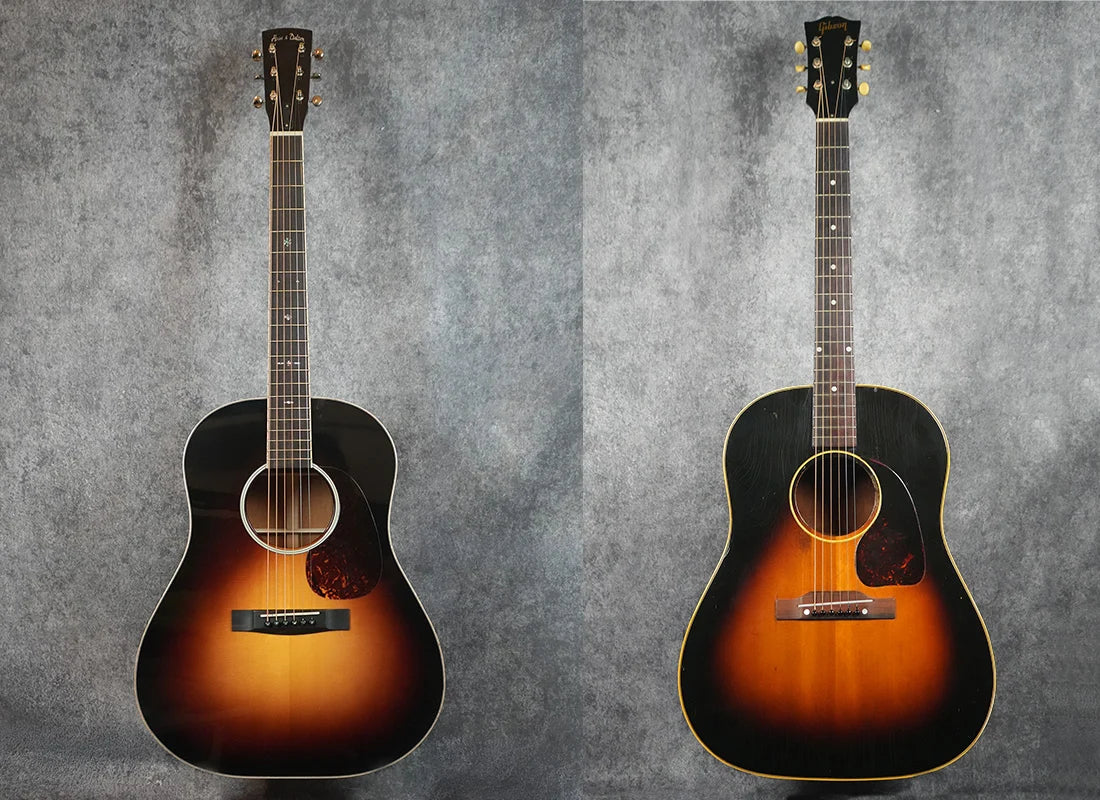
The handmade acoustic guitar market is vast, ranging from individual builders in small shops producing a handful of instruments a year like Jason Kostal, Ciaran McNally, Tyson Soth, and Paul Woolson, to boutique companies like Boucher, Collings, Huss & Dalton, and Gallagher, which build a few hundred annually with extraordinary attention.
What do players who go down this road say they find? A few things come up repeatedly.
Tonal complexity is one. A great handmade guitar doesn't just produce notes—it produces overtones and harmonics you can hear layered inside the chord. Play a G major on a fine handmade guitar, and you might hear things you've never noticed in that chord before. It's not louder or brighter necessarily. It's just richer.
Dynamic range is another. The ability of an instrument to whisper as convincingly as it shouts — to respond differently depending on how hard you play — is something factory instruments tend to compress toward a middle ground. A handmade guitar can go from a barely-there fingerpick to a full-throated strum and feel genuinely alive through the whole range.
And then there's fit. A boutique builder can make an instrument specifically for you — a slightly different neck profile to match your hand, a shorter scale length if your fingers are on the smaller side, whatever tonewoods suit the music you play. You can get a factory instrument that's close. You can get a handmade instrument that's yours.
Play a G major on a fine handmade guitar, and you might hear things you've never noticed in that chord before.
Mandolins: Small Instrument, Enormous Standards
If guitars are the big, accessible part of this world, mandolins are where things get almost obsessive. The carved archtop mandolin — the F-style and A-style instruments you see in bluegrass and folk — is genuinely closer to violin making than guitar building. The carved top and back have to be graduated to precise thicknesses that vary across the surface. Done right, the result is an instrument with explosive projection, crisp note separation, and a bell-like ring that carries across a band without amplification.
The benchmark for this instrument, set over a hundred years ago, is the pre-war Gibson F-5 mandolins built under the supervision of Lloyd Loar in the early 1920s. Those instruments are genuinely mythological in the mandolin world — when one comes up for sale, it goes for six figures. This tells you that the entire market for handmade mandolins is, in a real sense, a century-long conversation about what Loar's team got right.
The best contemporary builders — and there are some extraordinary ones — are in direct dialogue with that tradition. Players chasing a great handmade mandolin look for that tight, punchy chop for rhythm playing, sustain and complexity in single notes, and, above all, projection. Prices run from roughly $2,000 for a respected production shop to $10,000+ for the finest independent luthiers like Gary Lewandowski and Steven Thomas. It's serious money. Players who've made the commitment rarely describe it as a mistake.
Banjos: It's Complicated (In the Best Way)
The banjo is a genuinely different animal because the acoustic physics are so different. Unlike the guitar and mandolin, where almost everything happens in the wood, a banjo's tone is shaped by the interaction of a wooden rim and neck with a drumhead — originally animal skin, now almost universally a synthetic material called Mylar. Head tension, rim density, and a tone ring—a cast or machined metal ring that sits between the head and the rim—all shape the instrument's voice.
This is why banjo players sometimes seem especially particular. A small change in head tension completely alters the sound. Different tone ring materials — bronze, brass, bell metal — each have their own character. A builder who understands all these interactions and fits them together carefully produces an instrument that's simply easier to play and better to listen to than one where these factors were treated as afterthoughts.
The banjo world also has two genuinely different aesthetics, and they're not really in competition. The bluegrass banjo — five strings, a resonator on the back, tuned for projection — needs to be loud and bright and cutting. The old-time banjo — often open-back, warmer — is built to blend in an ensemble rather than cut through one. A good builder understands which instrument they're making and voices it accordingly. A factory line doesn't do that.
Quality boutique banjos begin around $2,000 and rise well past $8,000. The jump from a factory instrument is often immediately audible, which is useful to know before you spend the money: if you can play both side by side and can't tell the difference, that might matter, too.
Okay, But What Are You Really Buying?
Let's be honest about what goes into buying a handmade instrument, because tone is only part of it.
There's the story. A handmade instrument has provenance—this piece of Adirondack spruce came from a small mill in Vermont; the maple back has a particular curl that caught the builder's eye; the maker signed the inside label by hand. That matters to people, and there's no shame in admitting it.
There's the relationship with the maker. Many boutique builders are accessible people. You can email them with questions. Some will take your instrument back for adjustments. You know who built your instrument and often something about how they work and what they believe about the craft. That's nothing.
There's the community. Players who own handmade instruments tend to care about them the way some people care about wine or books—as objects with depth worth understanding. Owning one is an entry into that conversation.
And yes, there's the investment angle — though this should probably be the last thing you think about, not the first. Fine handmade instruments hold their value well and often appreciate. A guitar from a builder with a long waiting list doesn't depreciate like a mass-produced instrument. But if you're buying primarily as an investment, you'll probably enjoy it less than you should.
A great instrument doesn't make you a better player overnight. But it does make you want to play more, which, eventually, amounts to the same thing.
Before You Make the Leap: A Few Honest Thoughts
Play as many instruments as you can before committing. The handmade market is not a monolith. A guitar voiced for fingerpicking will feel unresponsive to a flatpicker. A mandolin built for bluegrass projection can feel stiff to a player who wants warmth for Celtic music. The right instrument responds to your technique and suits your music, not just the one with the most impressive reputation.
Understand what you're actually paying for. A luthier building four instruments a year, hand-selecting and hand-shaping every component, simply cannot price their work like a factory can. The premium is real, and it reflects years of time, attention, and skill. If that feels worth it to you, it probably is.
Don't let waiting lists put you off. Many of the most respected builders have waits of one to three years. That's not a bug — it's a signal that you're dealing with someone whose work people want. And the wait gives you time to save, to research, to be certain you want this particular builder's interpretation of this particular instrument.
Finally: if you get the chance to play a great handmade instrument before you decide, take it. All of this is easier to understand with one in your hands than in print.
Our goal at Wood and Wire Fine Fretted Instruments is to curate a collection of the finest boutique and hand-made instruments. Very few shops let you sit down and play such a wide variety of instruments from boutique and independent builders. Schedule an appointment on Tuesday or Wednesday for a personal consultation, or visit during regular business hours and experience the difference small shops make.


